I still remember the first time I saw “Pulp Fiction.” I was 13, visiting my cousin in Florida. He picked me up in a lifted jeep, his buddy and him chuckling something about “We are truly our brother’s keeper” (leaving the “finder of lost children thing as an aside). That was when you could still walk up to the gate without a ticket.
We cruised around Miami blaring the “Pulp Fiction” soundtrack (and “The Crow”, possibly the most 90s banger soundtrack ever dreamed of), and he sat me down and had me watch Quentin’s masterpiece, and Brandon Lee’s final film, and “One Flew Over the Cuckoo’s Nest.” It was the moment my life changed. We jumped off bridges into Hobie Bay and talked to girls and his jeep had no top or doors. Despite the fact I went down there to get my PADI card, what I really picked up was a discovery that the world was so much bigger, that I was sheltered (hell, all but stunted), and that this new Tarantino guy was a damn god.
I was raised on Lucas — I watched at least one “Star Wars” movie a week until I graduated high school and “Indiana Jones” will always be the movie character I most emulate (James Bond on outdoor adventures). But Quentin is the reason I fell in love with film, why I went on to work at a talent agency, why I loved going on deeeep dives in the Netflix DVD days, discovering everybody from Antonioni and Godard to Herschell Gordon Lewis. Eventually is was due to “Kill Bill” and the Wu-Tang clan that I fell in love with kung-fu and samurai movies and started practicing martial arts, culminating in a trip to Japan.
Recently life has been hectic. Being a father and stepfather and coach and homeowner, all while trying to make a buck in a world economy pushed down by the flapping of the right and left wings of the same shitbird, and get out for some physical kicks of my own, my film geekdom has seriously suffered. Then I read Quentin’s book “Cinema Speculation” (I’d already read, and written about, his novelization of “Once Upon a Time in Hollywood”). And listened to his “Video Archives” podcast. And thanks to Tubi I’m finally rediscovering the glory of deep film dives into the encyclopedic mind of any art form’s greatest geek/auteur.
From “Malibu High” to “One-Armed Executioner;” from “The Outffit” to “Bullitt,” I’m finding refuge in deconstructing the films of the most iconic director of my cinema-viewing life.
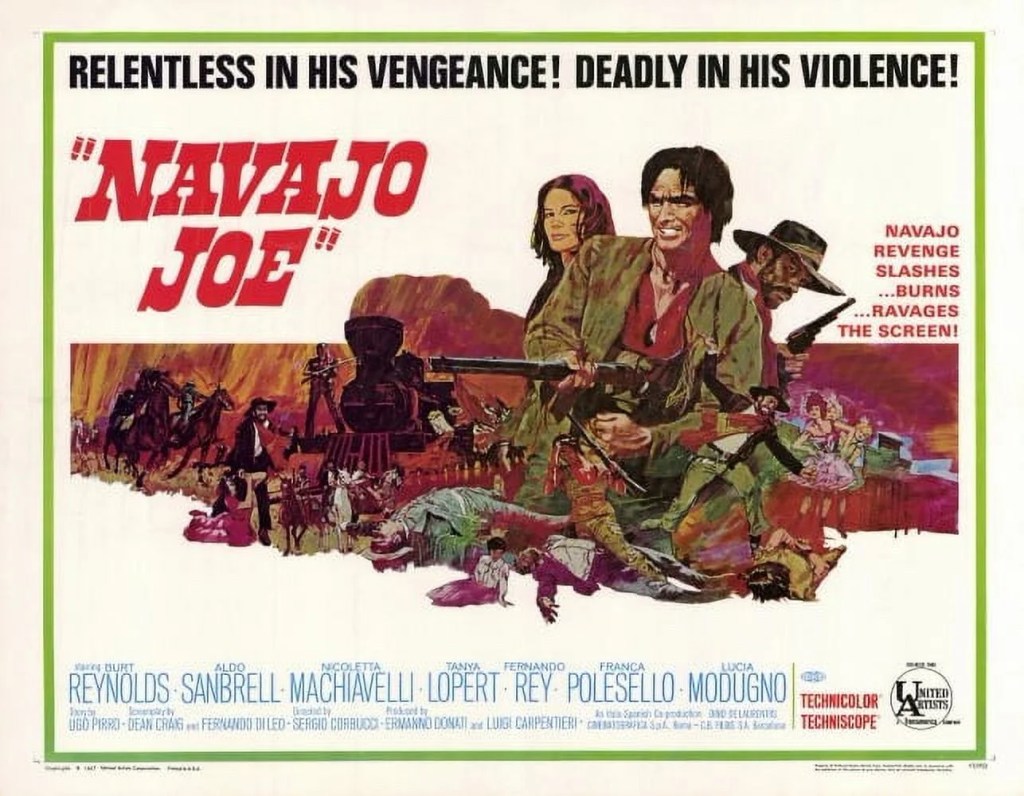
Along those lines, right now I’m watching “Navajo Joe.” Burt Reynolds in brownface. The inspiration for the fictional “Navajo Jim” that Rick Dalton takes on in Italy to refresh his career in “OUATIH.” I throw it on, again on Tubi (where my last couple views have been “Apocalypse Now” for the first time in a long time, and “Welcome to Blood City” an obvious inspiration for “Westworld”) then the first few notes, from Ennio Morricone, hit, the exact notes that ring in the background during the battle between the Bride and Elle Driver (hell, throughout the films, “dun dun dun DUN”) and I’m taken back to halcyon days of being young and on the coast, on the edge of the desert, jumping cinema house to cinema house in L.A. I’ve traveled back in time, to hard-boiled westerns (which I really loved when I lived back east) and obscure foreign films and early performances from actors I grew up identifying as old grizzled men (Jack Horner anybody?). I rediscovered cinematic discovery, jumping back to a time in life before responsibilities and stresses, before injury and the aches of a body long pushed to its limits made mortality feel all too real; before my house burnt down and before I’d discovered there are so many things I want to do and places I want to go with not enough time and resources for it all.
And it’s glorious. Now, if you’ll excuse me, Sergio Corbucci’s revengeamatic is about to culminate in the great slaughter of the gang of hicks who killed Navajo Joe’s people and no doubt it’s gonna be fire.

 Ryan's Word Riots
Leave a comment