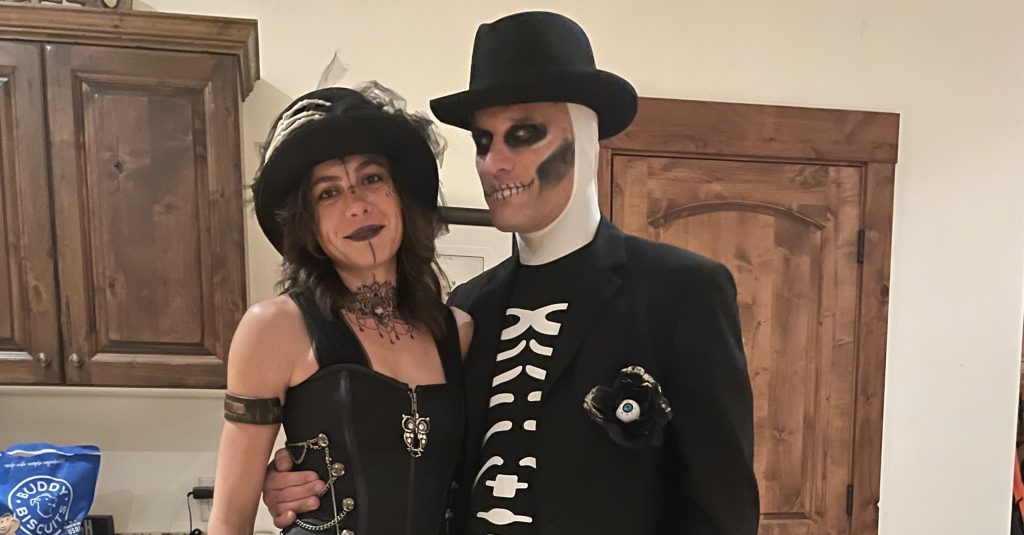
It’s that time of year, boys and girls: holiday season. Yep, we’ve put up with a year of work and school, of colds and injuries, of summer fun and summer heat, of great adventures (some of which we weren’t actually looking for), and now we’re heading into the final stretch. Saturday is Halloween, and from that point on we run the gauntlet through America’s greatest family eating holiday, the presents-and-Jesus-themed celebration of the solstice, and finally our big party night where we say goodbye to the old year and hope for a better one.
Of all these holidays, none has had the same journey as Halloween. Sure, there are evolutions over time — Christmas appropriated Yule when we outlawed paganism, so all the Nordic traditions of holly and snow were assigned to a holy man who was born and lived in the desert, and then a saintly Turk who liked to give kids gifts turned into a jolly fat dude in a red suit. Then there are evolutions over life — you believe in Santa Claus, you are Santa Claus, you look like Santa Claus. But none of the holidays have stretched so far as Halloween, and none change so drastically over your life as All Hallow’s Eve.
A CELEBRATION OF LIFE AMIDST DEATH
It all goes back to Samhain, the day when the Celts believed that the line between the world of the living and of the dead was thinnest. It was also a celebration of the end of the harvest, when the nights would grow longer and colder and they could get one last big party before needing to ration food to make it through the winter (emerging around the solstice for a rager marking the fact that the days were finally getting longer again). They lit a big fire on Samhain, sacrificed a few cows, and commoners and kings all partied together for a few days. Some chummy folks would go door-to-door and recite poems in exchange for treats, mostly probably food or booze. Others would pull pranks, likely hammered on mead.
But also, there’s the whole “spirits can walk among us thing.” So people would leave out gifts for dead family members who might come to the door. And they dressed in costume to hide from any bad spirits who also could come over, drag them back to the underworld. Usually folks dressed as animals because there were no sexy nurse or Spiderman costumes back then. But somehow they still had fun. Regardless, Samhain had some monsters and evil spirits that could really do horrible things. There’s thought that maybe there was some witchcraft going on too, but that could just be the Catholic church’s revisionist history wherein all northern religions were basically just devil worshiping. I mean, the Celts believed this time marked a removal of shame, and there were even supposed sex rituals — what’s less holy than enjoying other people’s bodies without shame?
Still, it was popular. In the Middle Ages, they carved turnips and put candles in them, using them as lanterns called jack o’lanterns, and there were more individualized bonfire parties. Likely the breaking up of the ragers at this time was part of the Christian political block, eh, religion, that was pushing hard for Ireland to join their less raucous but more sensible party. Still, the Pope realized it would be pretty tough to convince people they had to become more modest, marry just one person, AND give up all the parties that helped them get through the near-hibernation of Dark Ages winter. Just like they changed the solstice celebration of Yule enough to fit Jesus’ birthday party, so too did Samhain become All Saint’s Day.
ALL HALLOW’S EVE
That was the real miracle of the organized religion of Christianity, the appropriation and transformation of deeply-ingrained pagan traditions. Bawdy goat gods of sex and partying were reframed as the devil (originally, Lucifer was supposedly a very beautiful human-looking angel); celebrations of the return of the sun became the celebration of the birth of the Son; and church leaned into the idea of celebrating the spirits of the dead — the dead Saints, that is. Enter All Saint’s Day, on November 1st (Samhain was based on the moon between the autumn equinox and the winter solstice but the church was all about assigning specific dates, given how much easier it is to remember to go to church on the same day every year, especially when everybody was moved from whatever it was the pagans had to the organized Roman calendar named after Caesars like Julius and Augustus, and gods). Pope Gregory III decided Saints Day would be a bit of fun in the 8th century, and it also happened to be the period when Catholicism was finally taking hold amongst the Celtic heathens. As an added bonus, on top of the saints you could celebrate Aunt Eowyn, who lived a good enough life to be in heaven. For the ones in Purgatory, there was All Soul’s Day, on November 2nd, where you prayed that someday they’d finally get to ascend to heaven.
So the eve of All Hallow’s Day was All Hallow’s Eve. And the parties and fires maybe still happened but closing in on midnight they were moved from raucous benders in fields to more respectable singing and candles in a church. Mead was replaced by communion wine, so it maybe wasn’t as much of a rager but, you know, it was something to do with your community before concerts were invented.
And poor folks would go door to door offering to say prayers for the dead in exchange for sweets. And some of them would dress as saints or angels because, you know, dressing up is fun, and by this time animal skins and horns were associated with, you know, the devil. No doubt the Irish, always fond of community and free food and trickery like costuming, must have been the ones who pushed for this. You could replace Samhain but some of the fun had to stay.
MODERN HALLOWEEN
So this was kind of the deal for a thousand years. Turnips got replaced by the much larger and more practical pumpkins. Everybody in the Christian world adopted All Hallows Day (in Spain “Dia de Todos los Santos”) but for most of them it was just another religious holiday. The Irish still kept their Samhain traditions alive, though, just in a different costume. Then there was this whole Irish Potato Famine, and the ensuing influx of Irish and Scottish to America. There they met a lot of people who took themselves very seriously, and that was quite a shock to the system. So they decided to have some All Hallow’s Eve (diet Samhain) parties to get the Protestants to liven up. Apparently it worked.
While perhaps Americans weren’t the most jovial folks in the post-Revolution days, the idea of bonfires and drinking appealed to the national character, and going door to door exchanging words for food and drink was a smart trade for the citizens of world’s most capitalist country. And while rich people had been having costume balls for years, poor folk had no excuse to dress up; this holiday let everybody pretend to be somebody else for a night without looking like an idiot. Maybe Carl really wanted to be a cat; here was a night where he could dress like a cat and not get mocked at the butcher shop for saying he identified as a cat.
They started having a bit too much fun out here in the world’s wild west (way too much drinking and sex parties), so in keeping with America’s love of modesty, they turned to capitalism’s greatest weapon: marketing. And suddenly kid’s costumes started being mass-produced as they pivoted to the idea that Halloween dress up and door-to-door treat-begging was only appropriate for kids. This was in the 1920s, 1930s, times when America banned alcohol and started the National Legion of Decency. And given that most people were poor, it was still kind of a niche thing.
Then World War II happened and everything changed. When it ended, we were the only country still standing, and between that and a top tax rate of 94% the average American was now, like, the richest average person on the planet. And everybody was ready for some fun after having lived through 2 world wars, a depression, a dust bowl, and a bank run.
Now every parent took their kids trick-or-treating, and every house had tons of candy. Like the real shit, with actual sugar. And eventually the houses got all decked out in decorations. That jack o’lantern thing, that was there. And since it was a festival to honor the fallen souls and saints they added that spooky twist of spirits. Somehow Samhain crept back up with witches and ghosts, formerly not appreciated by the church but these people had seen real ghouls in the Argonne forest and Iwo Jima and Dachau; the old superstitions were no longer so frightening to their Christian sensibilities.
And those kids who went trick-or-treating grew up to be hippies, and they did drugs and had sex and no doubt had such a love of dressing up as kids they kept on with the tradition. So once again, adults could dress up.
In the past few years, there has been an influence from the Mexican side. Samhain had always been a party, and Halloween was just a redirected version of that. Dia de los Muertos, meanwhile, has a basis in ancient Meso-American traditions of celebrating the dead, opening the world to the underworld where the goddess Mictecacihuatl guarded the bones of the departed. It was more of a soulful, embrace-and-commune-with-the-dead-spirits thing. There were no monsters or evil spirits to fear like in Samhain (I guess the forests in Ireland were just spookier than the jungles of Central and South America). Then the conquistadores came, and saw it as an ideal holiday to roll into their Dia de Todos Los Santos. Dia de Los Muertos was about seeing spirits and hanging out. And the whole bones of the ancestors thing made skeletons and candy skulls a fun tradition, not scary. Still… there were ghosts and skeletons …
HOW HALLOWEEN EVOLVES OVER OUR LIVES
Like all our other modern holidays, your role in Halloween changes. Unlike the others, though, so do your celebrations, and that makes it unique.
When you’re a kid, your parents cook Thanksgiving dinner and everybody eats it together. When you get older, you have to cook it but that’s the only real difference. For Christmas, it’s a simple delegation of duties. Adults buy presents, kids get them; adults buy the tree, kids help decorate; putting up the lights on the house, watching cheesy movies, all of that’s the same. The only thing that changes is your role. Not Halloween.
When you’re a little kid, your parents take you out trick-or-treating. Maybe around 10 you go trick-or-treating by yourself. Your parents pick you up. By high school, you might still trick-or-treat but there are also now parties, and in some places dances. Trick-or-treating is over in young adulthood; then it’s all about dressing up (sexy or funny is the rule) and going out, and for many people about going out, getting twisted, and maybe having one of those classic costumed hookups. Ragers, full Samhain redux.
Next you’re a real adult. You either go to a house party where people are dressed up and having fun but nothing gets broken, random hook-ups happen considerably less, and most people keep sober enough to not get hungover. Or you have kids. And the cycle starts over but now it’s all about them. The priority is getting THEIR costumes. And taking THEM trick-or-treating. You might not even get to dress up. Or if you do, it might be for a few hours while your kids run around trying to get as much candy as they can, then you come home and maybe watch a scary movie while they count their swag. When they start going out trick-or-treating on their own, you’re still on call to pick them up. And while we Millenials are known for partying at bars like our much younger selves late into middle age (in a way that few other recent generations did), those house parties are the more likely avenue for the middle-age adult, when you can pick Halloween back up again.
HALLOWEEN EVOLUTION IN 2026
The religious traditions of All Saints Day have all but disappeared in modern America. Adults don’t trick-or-treat, but depending on where you live there may be some bonfires. Every city has haunted houses that range from silly to “Holy shit, just remember this is fake.” Streaming services feature horror movies, ranging from a million takes on demonic possession and zombies to the straight-up psychotic slasher flick. It’s still a spooky time of year though; one night, while running around 11:30, I could have sworn I saw a clown in the mist towards the end of the street.
Costumes can be ill-fitting pre-made action heroes and gangsters and sexy-everything purchased online or from the costume pop-up stores that take up a monthlong residence in closed office spaces and warehouses. Or people can be ironic takes on politicians, or cultural dynamics, or memes; folks dress up as professional athletes, and demons, and clowns (especially scary demon clowns), and celebrity couples. It’s not about celebrating the dead or hiding from the dead; it’s about creativity and playing dress-up, about having fun looking like whatever the hell you want to be. I’ve been Hunter S. Thompson more times than I can count.
Today Carl dresses like a cat year-round; for Halloween this year, he might dress up like a dog, just for the fun of it.



Leave a Reply